
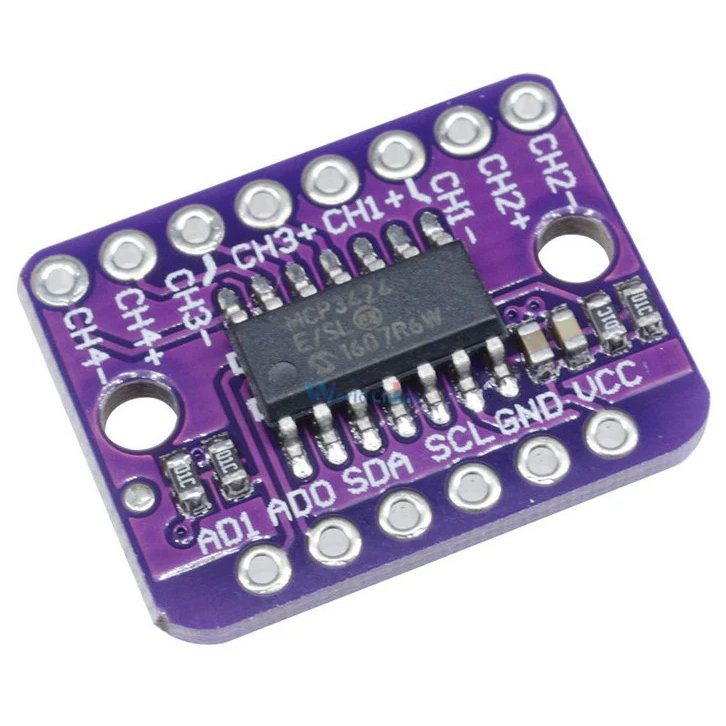
MCP3424 18-Bit ADC – 4 Channel with Programmable Gain Amplifier Breakout Board
1.800,00 EGP
Description
MCP3424 18-Bit ADC – 4 Channel with Programmable Gain Amplifier Breakout Board
The MCP3424 18-Bit ADC – 4 Channel with Programmable Gain Amplifier Breakout Board is a high-precision analog-to-digital converter module designed for applications requiring accurate low-noise signal measurement. Based on the MCP3424, it features four differential analog input channels, an integrated Programmable Gain Amplifier (PGA), and communicates through a simple I²C interface, making it ideal for Arduino, ESP32, Raspberry Pi, STM32, and other embedded platforms.
Features:
- High-precision 18-bit Delta-Sigma ADC
- 4 differential analog input channels
- Built-in Programmable Gain Amplifier (PGA)
- Programmable gain settings: ×1, ×2, ×4, ×8
- I²C communication interface
- Integrated 2.048V precision voltage reference
- Programmable resolutions: 12, 14, 16, and 18 bits
- Programmable conversion rates
- One-shot and continuous conversion modes
- Self-calibration for offset and gain
- Low power consumption
Specifications:
| Parameter | Value |
|---|---|
| Model | MCP3424. |
| Resolution | 12/14/16/18-Bit (Programmable). |
| Input Channels | 4 Differential. |
| ADC Type | Delta-Sigma (ΔΣ). |
| Reference Voltage | 2.048V (On-Board). |
| Reference Accuracy | ±0.05%. |
| Reference Drift | 15ppm/°C. |
| PGA Gain Options | 1, 2, 4, 8. |
| Input Range | -VREF to +VREF. |
| INL | 10ppm of FSR. |
| Gain Error | 0.05% (PGA=1, 18-bit). |
| Offset Error | 15µV (PGA=1, 18-bit). |
| Data Rate (12-bit) | 240SPS. |
| Data Rate (14-bit) | 60SPS. |
| Data Rate (16-bit) | 15SPS. |
| Data Rate (18-bit) | 3.75SPS. |
| Interface | I2C. |
| I2C Speed | 100kHz/400kHz/3.4MHz. |
| I2C Addresses | 8 (Selectable via AD0, AD1). |
| Operating Voltage | 2.7V-5.5V. |
| Continuous Current | 135µA (VDD=3V, Typical). |
| One-Shot Current | 36µA (VDD=3V, 1SPS, Typical). |
| Operating Temperature | -40°C to +125°C. |
| Pin Spacing | 2.54mm. |
| Package | SOIC-14 (Breakout). |
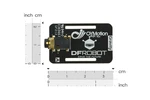
| Length | 20.5mm. |
| Width | 15.5mm. |
| Height | 3mm. |
Pin Configuration:

| Pin Position | Pin Name | Function/Description |
|---|---|---|
| Left Column (Top to Bottom) | ||
| Top | VCC | Positive Supply Voltage (2.7V-5.5V). |
| GND | Ground (0V). | |
| SCL | I2C Serial Clock (Input). | |
| SDA | I2C Serial Data (Bidirectional). | |
| AD0 | I2C Address Select Bit 0. | |
| Bottom | AD1 | I2C Address Select Bit 1. |
| Right Column (Top to Bottom) | ||
| Top | CH2- | Channel 2 Negative Differential Input. |
| CH2+ | Channel 2 Positive Differential Input. | |
| CH1- | Channel 1 Negative Differential Input. | |
| CH1+ | Channel 1 Positive Differential Input. | |
| CH3+ | Channel 3 Positive Differential Input. | |
| CH3- | Channel 3 Negative Differential Input. | |
| CH4+ | Channel 4 Positive Differential Input. | |
| Bottom | CH4- | Channel 4 Negative Differential Input. |
Applications:
- Precision Voltage Measurement
- Sensor Data Acquisition
- Load Cell Interfaces
- Pressure Sensors
- Strain Gauge Measurement
- RTD & Thermistor Measurement
- Thermocouple Applications
- Industrial Automation
- Battery Monitoring
- Weighing Systems
- Arduino Projects
- ESP32 Projects
- Raspberry Pi Projects
Package Include:
- 1x MCP3424 18-Bit ADC – 4 Channel with Programmable Gain Amplifier Breakout Board
- 2x pin header straight(6pin, 8pin)
Documents:
Reviews (0)
Shipping and Delivery



Reviews
There are no reviews yet.